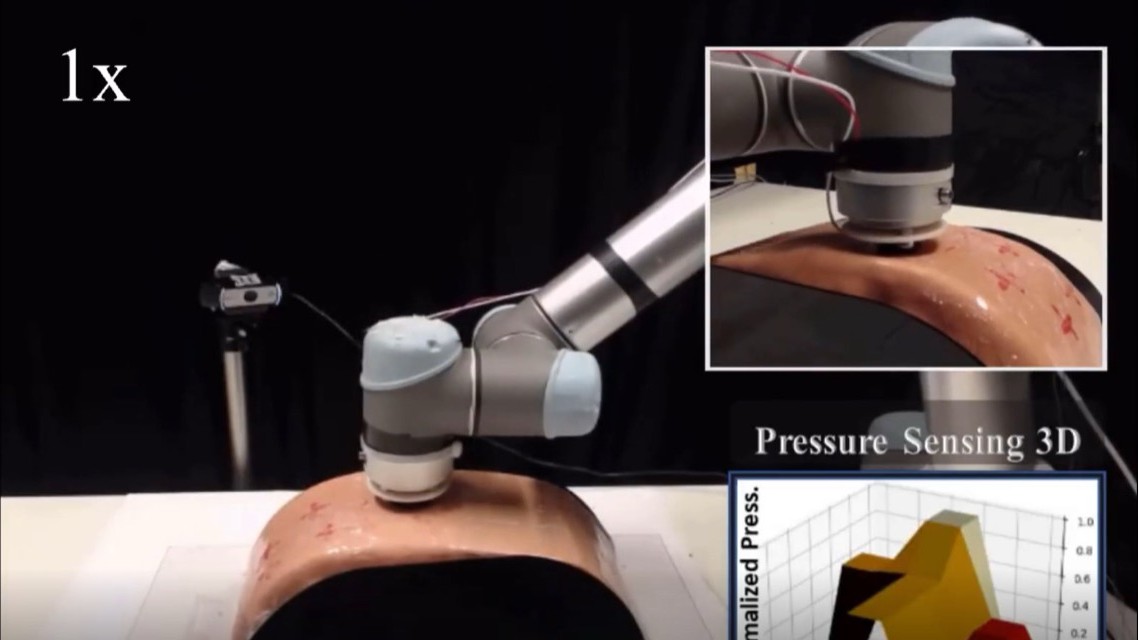
An article published by the University of Cambridge describes part of my work on using AI and robotics in medicine.
RoboPatient is a collaborative project funded by the EPSRC, bringing together researchers at the University of Cambridge, Imperial College London, and the University of Oxford. It asks how advances in soft robotics and tactile sensing can help teach trainee doctors palpation: examining a patient by feeling the size, texture, and position of organs with the fingers and hands. Palpation is hard to teach, and usually takes a great deal of hands-on practice with real patients.
The article describes a first step, published in Autonomous Robots. A robotic arm with a tactile sensor probes a soft silicone phantom organ, and machine learning helps choose the probing motions that best reveal the hard inclusions hidden inside it, before any labeled data is needed. I cover that study in its own post.
Read the full article on the Cambridge Engineering website.
Finding the right touch
We have published part of this work in the robotics journal Soft Robotics. The research article is titled “Action Augmentation of Tactile Perception for Soft-Body Palpation”. In it, we take a closer look at physical medical examination: we use a robotic platform and a mathematical framework both to understand and to employ complex palpation strategies, in order to achieve appropriate sensory perception for robotic medical diagnosis.
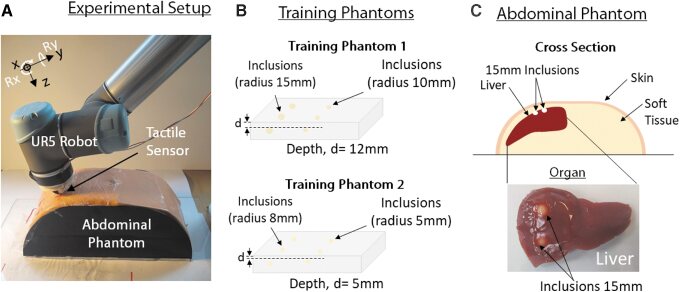
Palpation can reveal signs of conditions as serious as cancer, yet the technique is still poorly understood, because the interaction between a doctor’s hands and soft tissue is so complex. Our robot palpated two flat training phantoms and a more lifelike abdominal phantom with a silicone liver inside. Each palpation combined pressing with rotation about two axes, giving 64 different trajectories to compare.
Using a Bayesian framework for training and classification, we found that telling abnormal inclusions apart requires complex, multi-axis palpation trajectories, and that this probabilistic approach can search the robot’s large space of possible actions quickly. The strategies it found could confidently detect inclusions as small as 5 mm in diameter. Small changes to the trajectory, or to the “patient,” noticeably changed performance, so the best palpation has to be found for each patient, much as doctors adapt their touch.
What comes next
The next phase of RoboPatient turns to the patient’s side of the examination. Working with Imperial College London, the project will collect data on how palpation feels to the patient, capturing reactions such as pain, facial expressions, and even verbal cues. Imperial’s soft phantom organ, fitted with sensors, and a robotic face that shows expressions of pain can then help guide how a doctor performs the examination.