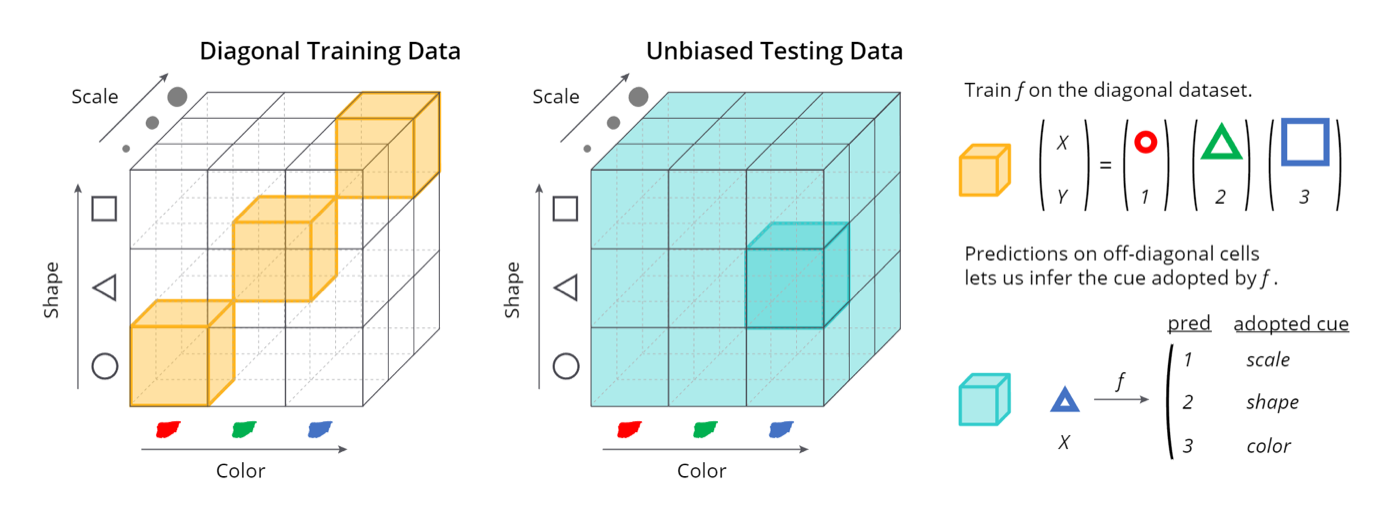
Deep neural networks (DNNs) often rely on easily learned discriminatory features, or cues, that are not essential to the problem at hand — a phenomenon known as shortcut learning. A DNN may recognize ducks based on the typical background scenery of lakes or streams rather than on the ducks themselves. This shortcut bias limits generalization, particularly in harder test scenarios where the shortcuts are no longer valid.
To investigate the shortcut learning tendencies of deep models we introduce a new training setup: the Wisconsin Card Sorting Test for Machine Learners (WCST-ML).
The Wisconsin Card Sorting Test for Machine Learners
We envision a simple, yet powerful, setting. Imagine you were given this limited set of images and labels:
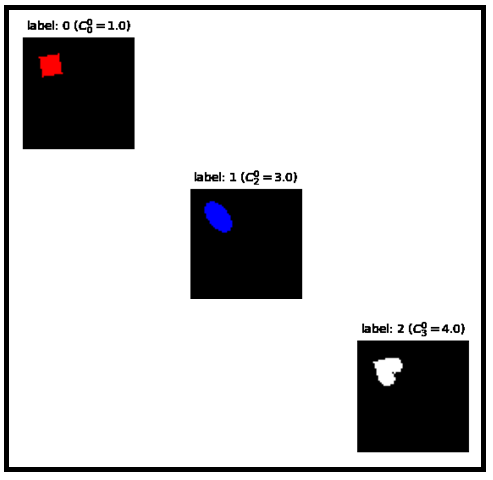
You are then asked to provide a label for the following image. You can choose between 0, 1 or 2, according to your understanding of the task:
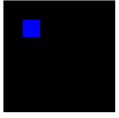
The problem with this question lies in its ill-defined nature. The images and labels in the training matrix are fully correlated with respect to at least two interpretable high-level cues — for example shape and color. At training time the classification task can be solved perfectly by relying on either feature; at test time, an image showing an unseen feature combination requires generalization.
If a human were to solve this task, several factors could play a role in the final decision. Prior knowledge about the world, the task, or even other related tasks might influence our beliefs about the underlying task to solve — yes, in a Bayesian sense. Ideally we would form a set of hypotheses (hopefully containing both shape and color as alternatives), and make a choice given our prior and our observations, updating as we see more data. The important part is that the choice we make is informative of our priors, and of our biases. Absent a significantly different prior among participants, labeling the image 0 would display a bias toward shape, while labeling it 1 would showcase a color-based task logic.
During training, deep learning models have their own biases, and have often been observed to collapse to easy-to-learn cues. Similarly to the degenerate classification case above, available datasets typically underspecify the task to be solved, and data is hardly ever comprehensive enough to fully constrain decision-making.
Models agree on which shortcuts to take
In our work we run extensive experiments to observe how different architectures react when put through a similarly underspecified visual discrimination task. Our first interesting finding is that, despite the different inductive biases induced by different architectures, we observe largely similar behavior across models. Models reliably prefer certain cues — like color — more than others. Color is a particularly easy cue to fit in the simple example above, since we have some intuition about how it might be solved by something akin to channel selection in the input space.
Experiments on more complex datasets, such as UTKFace, show that cues such as ethnicity, gender, and age also rank similarly across architectures, exposing potentially sensitive biases when performing inference without appropriate measures or human-in-the-loop solutions.
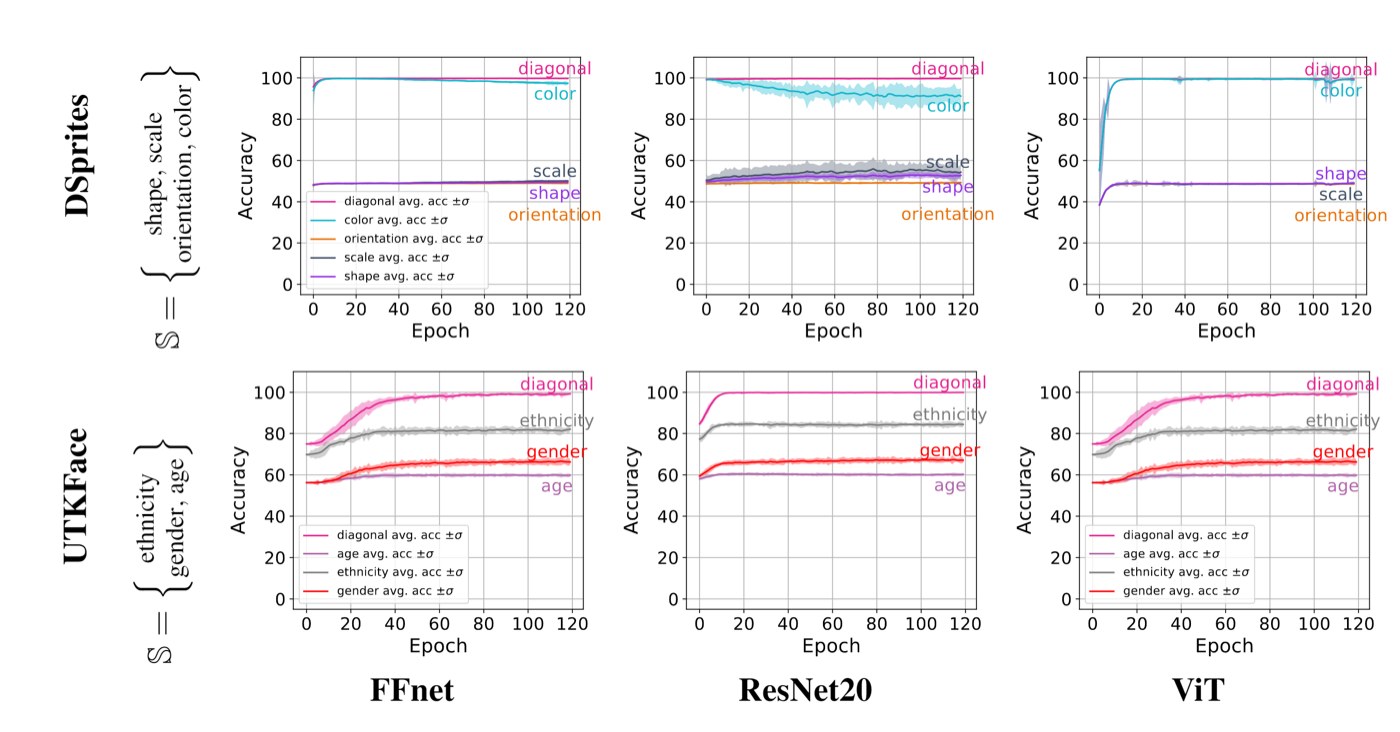
Interestingly, we find these biases can be explained by the loss landscape: the set of solutions biased toward the preferred cues occupies a far greater volume — and tends to be flatter — than those corresponding to the less-preferred cues.
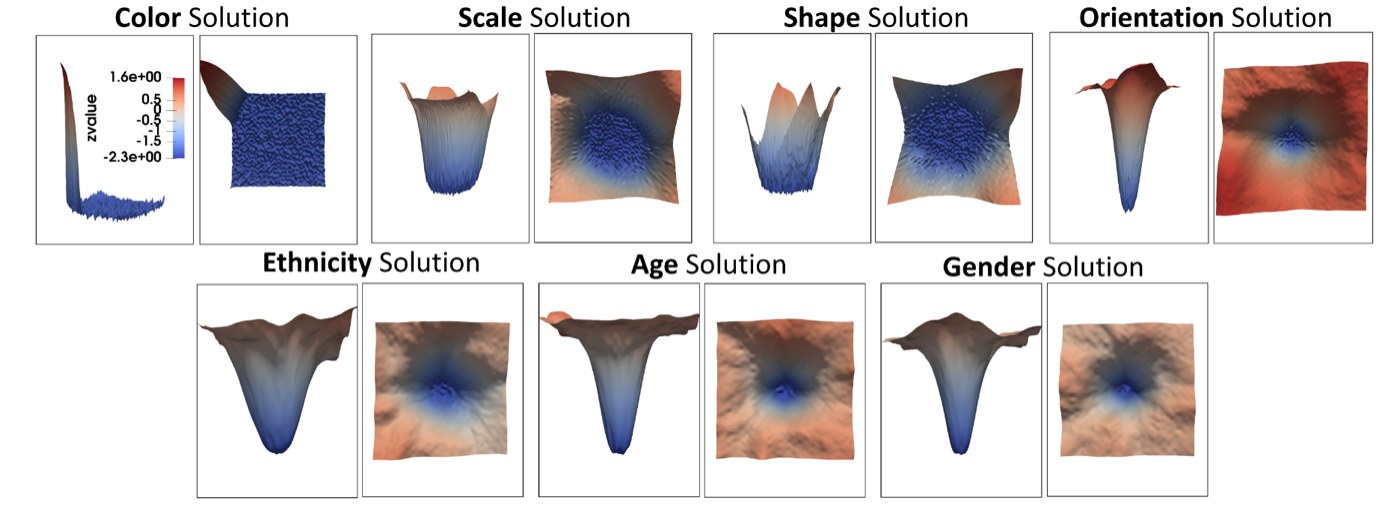
We call this fully correlated test WCST-ML, and propose a simple framework for exploring any such biases. As long as a dataset has multiple labels for each input, and enough elements to generate a fully correlated dataset, WCST-ML should be readily applicable. The ICLR paper goes into much more depth, showing what these shortcut biases look like during training and how they might be avoided. These findings shed light on shortcut learning in deep models, and emphasize the importance of solutions such as active human intervention to remove model biases that may cause negative societal impacts.
Mitigating the bias with diffusion counterfactuals
In follow-up work, we propose a solution based on ensemble diversification. An effective approximation to the Bayesian ideal above is to let an ensemble of models entertain a range of diverse hypotheses while observing the degenerate training data. The diversity must be functional, and is therefore not trivial to enforce.
We propose a method based on synthetic counterfactuals sampled from an appropriately trained Diffusion Probabilistic Model (DPM). We find that DPMs pass through a stage of training in which they are more likely to produce samples with novel feature combinations — an originative stage.
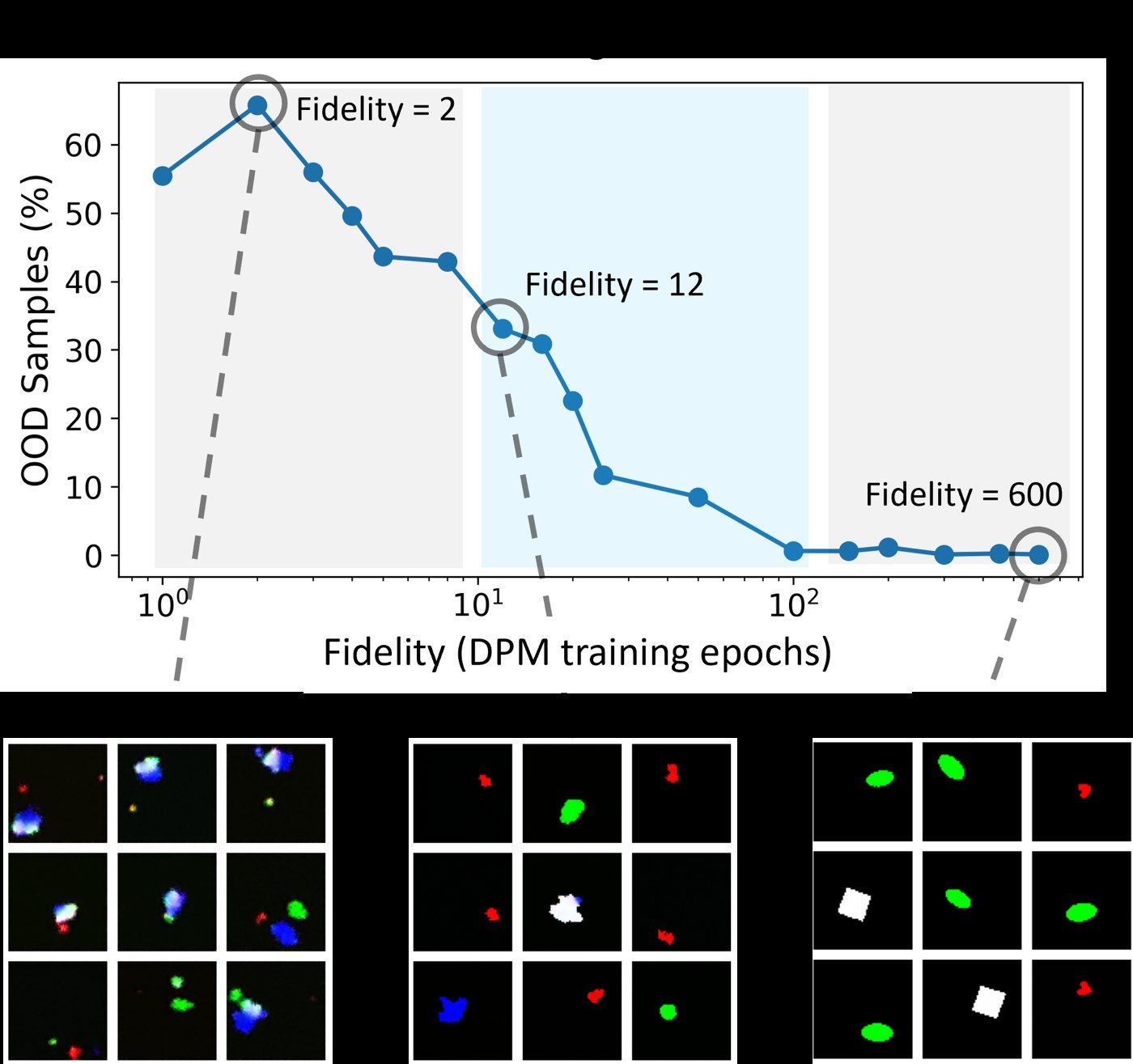
Even when lacking fidelity, these samples can be leveraged directly for ensemble diversification through model disagreement, enforcing functional diversity across models.
In the table below you can see the fraction of models that attend to a given cue (out of an ensemble of 100) when trained without diversification — the baseline case above — and when trained with our diversification method.
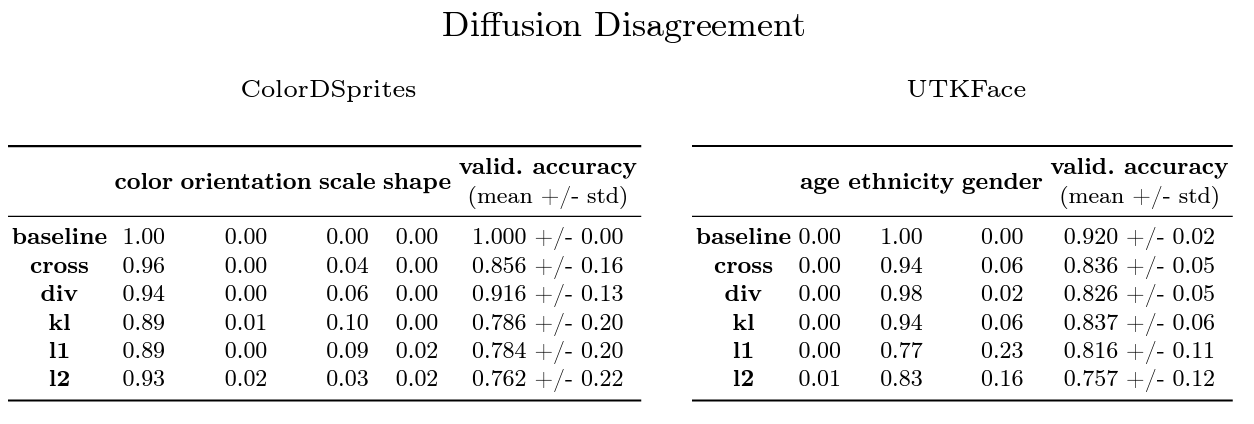
This demonstrates that we can get models to attend to non-shortcut cues, even without the need for expensive additional data collection.