Our paper in PLOS ONE, written with Cheryn Ng and Fumiya Iida, proposes a Gaussian process–based framework that lets a robot use sound feedback to learn to play the piano in ten different styles.
The piano takes humans years of practice to learn, and much of the skill lies in details that are hard to see: how fast a key is struck, how long it is held, and how it is released. These details matter most for the delicate expression of advanced pieces. By studying the physical interaction between player and instrument, we hoped to gain insight into human dexterity and adaptability.
Our hypothesis was that the relationship between how a key is pressed and the sound it produces is highly nonlinear. To test it, we kept the platform minimal: a UR5 robotic arm with a single elastic, 3D-printed finger, playing a digital piano. The robot performed 3,125 key presses with varied control parameters, while the piano recorded the sound of each one as MIDI data.
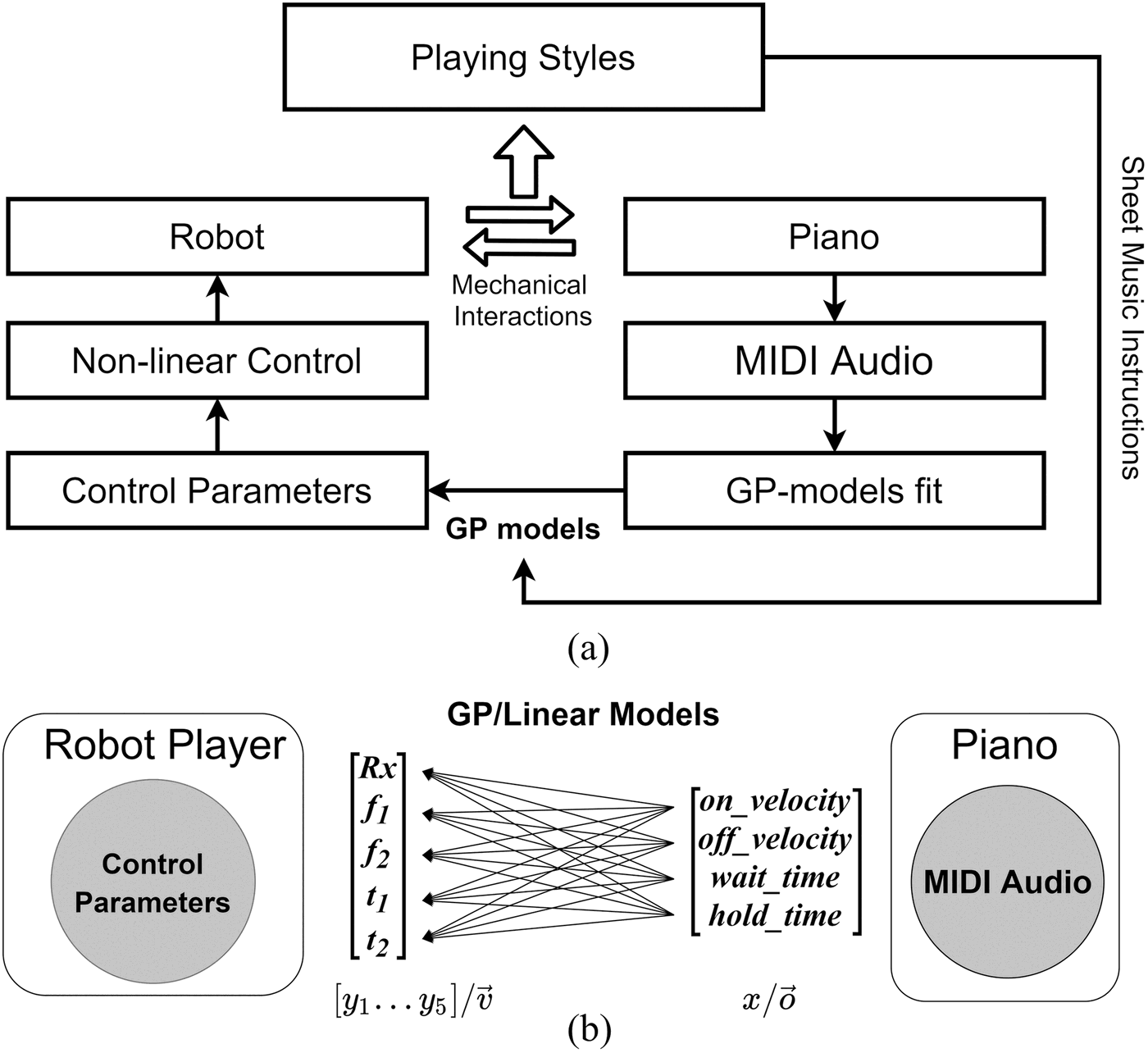
From this data, we trained Gaussian process (GP) models for ten playing styles, covering articulations such as staccato and tenuto, and dynamics from fortissimo down to pppp. Comparing the control parameters with the sounds they produced confirmed a strongly nonlinear relationship, especially for rich expressions such as a wide range of dynamics. Linear regression models found this relationship difficult and slow to learn, compared with our GP-based approach.
Finally, we compared the robot with an experienced human pianist playing the same styles. For some expressions the robot’s sound came close to the human’s; others will need further investigation.