In the ever-evolving landscape of artificial intelligence, diffusion models have emerged as a powerful tool for generating high-quality data across domains such as images, text, and even action spaces. But what happens when we need these models not just to generate, but to adapt to specific constraints? We tackle exactly this problem in our paper “Amortizing Intractable Inference in Diffusion Models for Vision, Language, and Control”, where we propose Relative Trajectory Balance (RTB) — an asymptotically unbiased training objective for diffusion models that sample from posterior distributions under a diffusion model prior.
Tackling the intractable: why posterior inference matters
Diffusion models generate data by transforming noise through a series of steps. In real-world applications, however, we often need them to conform to certain constraints — think of generating an image with specific features, or producing text that adheres to a given context. This leads us to the problem of posterior inference, where we want to sample data that fits both the original prior distribution and the additional constraints. The catch? This posterior inference is typically intractable.
Relative Trajectory Balance
At its core, RTB is about being able to fine-tune a diffusion model prior into a posterior model, and sample according to the posterior distribution of interest. Ideally the posterior model should not drift too far from the prior — we want the samples to remain plausible under the original prior — but it should nonetheless change appropriately to capture the posterior of interest.
When tackling the posterior sampling problem, the goal is to sample from a posterior distribution $p_{\text{post}}(\mathbf{x}) \propto p_\theta(\mathbf{x})\, r(\mathbf{x})$, where $p_\theta(\mathbf{x})$ is our diffusion model prior and $r(\mathbf{x})$ is the constraint. Importantly, $r(\mathbf{x})$ does not need to be differentiable: it can be a measurement, a reward from another model, a human preference — anything, really.
Our RTB objective introduces a constraint that enforces the correct relationship between the prior and the posterior processes:
\[\mathcal{L}_{RTB}(\mathbf{x}_0 \rightarrow \mathbf{x}_{\Delta t} \rightarrow \dots \rightarrow \mathbf{x}_1; \phi) := \log\left(\frac{Z_{\phi} \cdot p_\phi^{post}(\mathbf{x}_0, \mathbf{x}_{\Delta t}, \dots, \mathbf{x}_1)}{r(\mathbf{x}_1)\, p_{\theta}(\mathbf{x}_0, \mathbf{x}_{\Delta t}, \dots, \mathbf{x}_1)}\right)^2\]This ensures that the likelihood of the denoising trajectory under the posterior model $p_\phi^{post}$ stays close to the likelihood of the same trajectory under the prior $p_{\theta}$, while learning the scalar $Z_{\phi}$ (in log scale, for numerical stability) and sampling proportionally to $p_\theta(\mathbf{x})\,r(\mathbf{x})$. Thanks to its design, the advantage of RTB lies in its ability to achieve unbiased posterior sampling — proof in the paper.
Highlights
To show the effectiveness of RTB we provide a diverse set of empirical results across multiple domains. Some highlights:
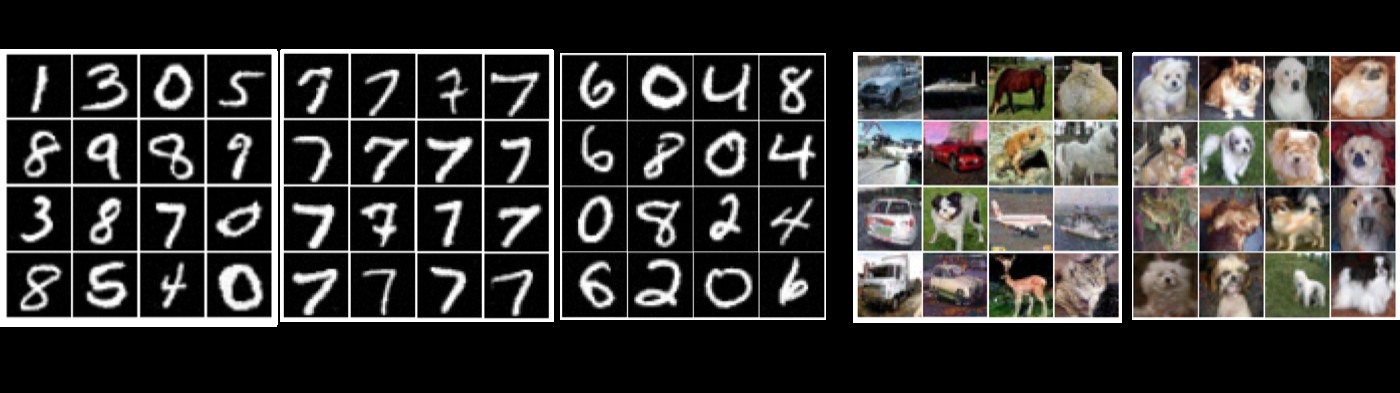
In vision, RTB applied to image generation achieves state-of-the-art results, improving on classifier guidance and RL-based baselines in both the diversity of the generated posterior samples and their closeness to the true posterior. Below is an example of fine-tuning an unconditional diffusion prior.
In stable diffusion, we can fine-tune a large text-to-image model to achieve high scores according to human preference, on par with state-of-the-art methods.

In language, we show we can fine-tune a posterior over a discrete language diffusion model prior to perform coherent posterior sampling for text infilling.
In reinforcement learning control tasks, we report state-of-the-art results when training a posterior behavior policy from a diffusion behavioral prior, achieving comparable or better results than other recent methods.
Conclusion
Relative Trajectory Balance is a flexible objective that allows efficient and unbiased sampling from a posterior distribution, given a diffusion prior and a reward or likelihood. The empirical results across vision, language, and control underscore the potential of RTB to set new benchmarks across AI applications. Whether you are diving into research or developing practical solutions, the advances presented here are poised to change how we generate and refine data.